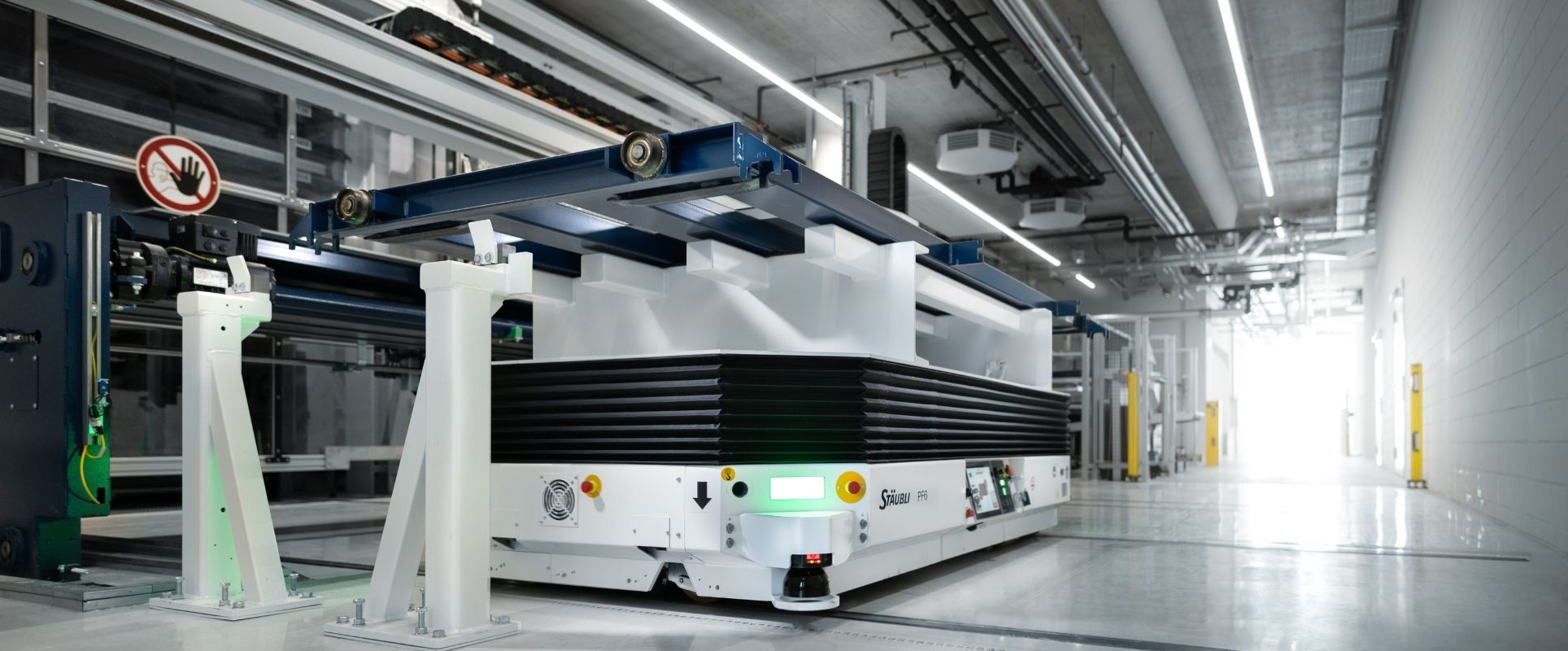
Automated guided vehicles are everywhere in the conversation right now. Walk any manufacturing exhibition floor, open any trade publication and the message seems to be that AGVs are the future, and if you're not already deploying them, you're falling behind.
But that framing does manufacturers a disservice. The more useful question is not whether AGVs (or mobile robotics if you prefer) are essential but whether they are right for your business, your processes and your people.
Jennifer Hughes, general manager at Transicon, and Jan Louwen, global head of AGVs at Stäubli, share what manufacturers need to consider before taking the plunge.
Keep it simple
The number one mistake manufacturers make when approaching AGV projects is reaching for complexity before they have mastered the basics.
Jan's advice is to start with the simplest, most straightforward process you can find, build confidence, demonstrate value and then scale. Trying to automate your most complicated material flow on day one is a recipe for delays and frustration — and it is a trap that many businesses fall into, particularly when enthusiasm for the technology outpaces the groundwork needed to deploy it properly.
Mobile robotics or AGVs are, at their core, material flow solutions. They move goods from one point to another. The technology itself is mature and globally proven. What determines success or failure is how well the automation aligns with the processes around it.
That means defining your objectives before you define your specification. What problem are you actually trying to solve? Is it a safety issue, a labour shortage, inconsistent throughput or something else entirely? The answers will shape everything that follows — from the type of AGV you need to how you measure return on investment.
Bring your people with you
Once you have defined your need and agreed the business case stacks up, involve the workforce early. Early, honest communication is not optional — it is essential if you want a successful outcome.
Projects that run into serious difficulties often do so not because the technology failed but because the people on the shop floor were never properly brought into the process. Operators who feel a decision has been imposed on them will, at best, be reluctant users. At worst, they become active obstacles.
Jennifer's advice is to engage operators from the very beginning. Be transparent about what is changing, why it is changing and what it means for their roles. Provide hands-on training before going live, not on the day of it. Where possible, use tools such as virtual reality walkthroughs to help people visualise the new environment before it exists.
Operators who are involved early, who have had the chance to ask questions and raise concerns, consistently become the strongest advocates for the technology. Those who are surprised by it rarely do.
Know your site, know your load
Practical site and operational factors can significantly influence whether an AGV deployment is viable — and what it will cost.
Jan believes that floor conditions are one of the most commonly overlooked issues when it comes to mobile robotics. Many industrial environments are far from the clean, level surfaces that AGVs perform best on, and retrofitting a brownfield site can add considerably to project costs. Safety zones and rescue spaces are a legal requirement and will affect both AGV speed and throughput in constrained environments.
Load characteristics matter too. Jan highlights that the centre of gravity of your typical load, the dimensions of your largest load and — critically — how handover points between conveyors and AGVs are designed will all influence how smoothly the system operates.
Timelines also need to be realistic. A straightforward AGV project, from initial conversation to live operation, typically takes between six and nine months. Complex deployments involving multiple control system integrations and bespoke interfaces can take considerably longer. Getting IT, maintenance, finance and operations teams involved early is not a nice-to-have — it is what keeps projects on schedule and budgets intact.
The technology is not standing still
For those thinking about the longer term, AI and vision technology are already reshaping what AGVs can do. Vision sensors are improving obstacle recognition and navigation accuracy, while AI-driven fleet management software is becoming an increasingly important differentiator between systems. Full autonomy remains a longer-term prospect, but the pace of development is clear.
For most manufacturers, Jen says the question is not whether to engage with this technology eventually — it is whether the conditions are right to do so now and whether the groundwork has been laid to give a deployment the best possible chance of success.
Get the process right. Keep it simple. Talk to your people early. The technology will follow.
Transicon's Industry Masterclass series
This article draws on advice shared at the first session in Transicon's Industry Masterclass series — a programme of practical, engineering-led webinars designed to help manufacturers cut through the noise and make better-informed automation decisions.
Transicon is an automation and control systems specialist based in Telford. The company has been delivering bespoke automation and control systems since 1967 and works with major manufacturers across a range of sectors including automotive, food and drink, steel and pharmaceuticals. Its approach has always been to understand the specific needs of a business first and apply technology in service of those needs, rather than the other way around.
The masterclass series reflects that philosophy. Each session brings together Transicon's engineering team alongside specialist partners to explore the issues that matter most to manufacturers navigating an increasingly complex automation landscape.
The next session will partner with Siemens on July 21 to examine cyber security in manufacturing — an area of growing importance as manufacturers become more connected and more exposed to digital risk.
Want to find out more about AGVs?
You can read more on our FAQs page.