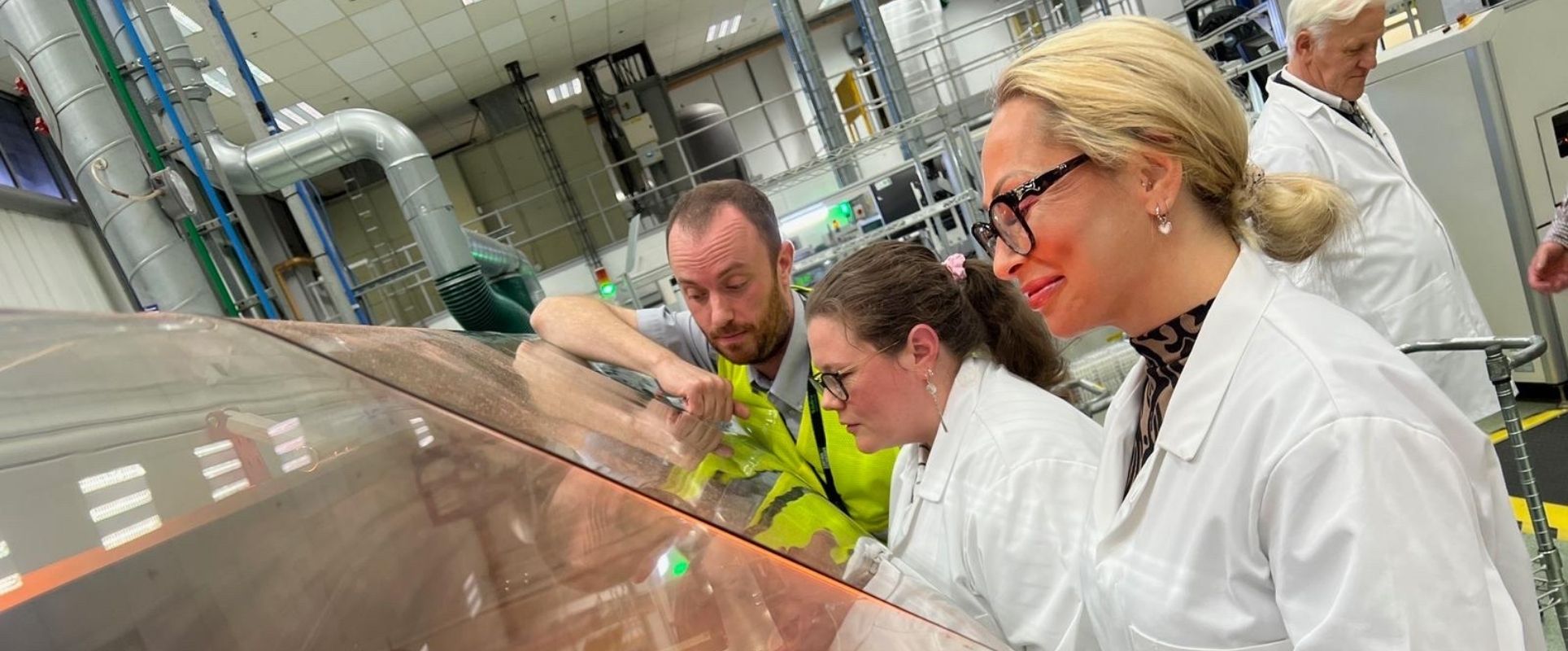
As Transicon expands its presence across the UK to support more manufacturing businesses, Laura Hayton, recently appointed as head of business development for the north shares her thoughts on the challenges facing manufacturers, the role of women in engineering and how Transicon is helping to future-proof businesses.
Could you tell us about your professional background and what attracted you to join Transicon?
I started my career in hospitality when I was about 17 years old working in some of the most prestigious hotels and restaurants in Yorkshire. This work, I believe, gave me a great foundation for the customer service skills and communications that I have today. At age 20, I then moved into sales working across various sectors including telecommunications, beauty and B2B business but truth be told I found all the products I was selling uninspiring. I pivoted slightly and studied for a diploma in marketing but after a year in a marketing role realised my passion really was sales and I just needed to find the right sector to work in.
It was at this point I was introduced to an electrical engineering through Halcyon Drives, where I began working with power control and variable speed drives as an ABB partner. Quite honestly, I fell in love with the industry – the problems, the engineers, the solutions and watching a project come together.
Despite having no engineering qualification or background, I spent 14 years at Halcyon eventually managing a sales pipeline worth around £5 million. Proving to me that if you have good industry knowledge, a passion and a strong work-hard ethic then an engineering qualification wasn’t entirely necessary for carving a career in the industry.
I loved supporting customers and building relationships, finding a niche as someone who could translate technical engineering concepts into solutions that addressed clients' problems.
My time at Halcyon was filled with many career highs nut in 2022 I decided it was time for a new challenge and I moved to ABB's medium voltage division, working on much larger projects. The scale of projects was vast, and it was fantastic to have experience of working for a leading multi-national company.
In 2025 however I decided to get back to the grass roots of the industry and when I heard about Transicon’s growth plans it felt like the perfect opportunity. I’ve been here for a few months now and absolutely loving it.
What exactly does your role as head of business development of the North involve?
My role is to expand the business in the north of England region. Transicon has a team of extremely talented engineers but naturally they are too busy innovating and working on client projects to speak to potential new clients about how our automation services can support them.
That’s where I come in. I’ll be working to increase business relationships, have conversations with potential clients about our expertise and raise our company profile across various sectors including automotive, aerospace, defence, chemicals, environmental, metals, packaging, plastics and utilities and waste.
If there is an industry which we can serve I will be finding ways in which we can support them. Ultimately, we are one of the most trusted system integrators within the UK and as more businesses look to innovate, modernise and future-proof their production lines my role is to ensure that Transicon is part of that journey.
What are the main challenges manufacturers face today, and how is Transicon helping them overcome them?
One of the biggest challenges in manufacturing is the resource gap. Fifteen to twenty years ago, manufacturers had operational engineers, maintenance engineers, and project managers with dedicated budgets. However, following the credit crunch, many people left engineering and never returned, budgets were stripped and the loss of engineers created a significant skills gap between Gen X/millennials and Gen Z.
Add into the mix the fact that manufacturers are operating with ageing equipment, that it’s becoming harder to source replacement parts and that many of the existing skilled engineers who know this equipment inside out are facing retirement then potentially we have the perfect storm for sector-wide production challenges.
That's where Transicon comes in. Manufacturers can access our specialist resource as and when they need it, allowing their own teams to focus on daily operations.
When equipment fails, it's not just a broken machine; it translates to potentially hundreds of thousands of pounds in downtime and production losses but what we do is design, build and integrate bespoke industrial automation and control systems to help future proof production lines, reduce costs and improve energy efficiency.
Our mechatronics division combines mechanical engineering and electrical control systems to provide cutting-edge solutions and we are experts in GEM80 upgrades having installed much of the original outdated technology.
As a woman who's built a successful career in engineering sales, what challenges have you faced and how have you overcome them?
I've faced some significant challenges in my career particularly in the early days but a lot of it boiled down to the fact it was unusual back then for women to be seen operating in a male-dominated industry.
I’ve faced sexism, I have faced ageism when I initially started, but I stayed in the industry that I loved. Not one to give up it added fuel to my fire and made me even more passionate to succeed.
Thankfully a lot has changed and the industry isn’t the same as it was when I first started out. Overcoming the challenges however wasn’t easy but I did so by focusing on my technical knowledge and demonstrating my ability to understand and solve problems. I chose to step into my intelligence, be curious, authoritative, and position myself as an equal rather than playing into stereotypes. My passion is and has always been people and human connection, how we can support our clients effectively and with a high level of service, this has always seen me succeed.
Why is diversity particularly important in engineering and manufacturing?
Diversity brings different perspectives, each of us sees the world differently, each of us have different strengths with our brains. Different people see and understand differently. The collaboration between those brains is extremely powerful.
In engineering specifically, when you're developing solutions, a diverse team will approach problems differently. The combination of perspectives is where innovation happens – people bounce ideas off each other, question assumptions, and create better solutions.
Women in engineering bring what I'd call a different energy – understanding problems at a softer level and bringing more balance to workspaces. For women in roles like mine, building relationships often comes naturally.
I believe the pattern of male-dominated thinking in engineering can benefit enormously from the different perspectives that women bring and I’ll continue to champion the role of women in engineering to strengthen our industry.
How do we attract more young people, particularly young women, into engineering?
We need to make engineering exciting again. We're now in the TikTok generation where young people are seeing influencers succeed on social media platforms, and by comparison, engineering doesn't sound fun.
But of course, those who work in the industry know that’s not true. Engineering is fascinating, it’s exciting and revolutionary. Engineers have created everything around us – mobile phones, computers, everything we use daily. We need to help everyone get excited about our industry and we need to open our doors a little more. This is something we’re hugely passionate about at Transicon. We recently threw open our doors for National Manufacturing Day and it was positively received by school children. They went home inspired, engaged and some even wanting to return for work experience.
For girls specifically, I think we need to recognise that different brain structures might lead to different interests, but there are many roles in engineering beyond fixing things. We shouldn't force people into roles that don't match their interests, but we should continue to showcase the full range of opportunities available.
Looking ahead what do you see as the future trends in automation and engineering?
AI and cybersecurity are going to be the biggest trends. As systems become more intelligent, cybersecurity becomes critical. We'll need robust barriers against potential threats, especially as manufacturers modernise their infrastructure.
For Transicon specifically, our future is about growing our team and raising our profile so people know we can provide that helicopter support they need. We'll be working on increasingly interesting projects that clients don't have the capacity to handle themselves.
My goal for Transicon is to increase the awareness that we are one of the UK's most trusted system integrators and automation partners. When manufacturers need quality work, I want them to immediately think of Transicon as honest, ethical and empathetic engineers who will do an excellent job.